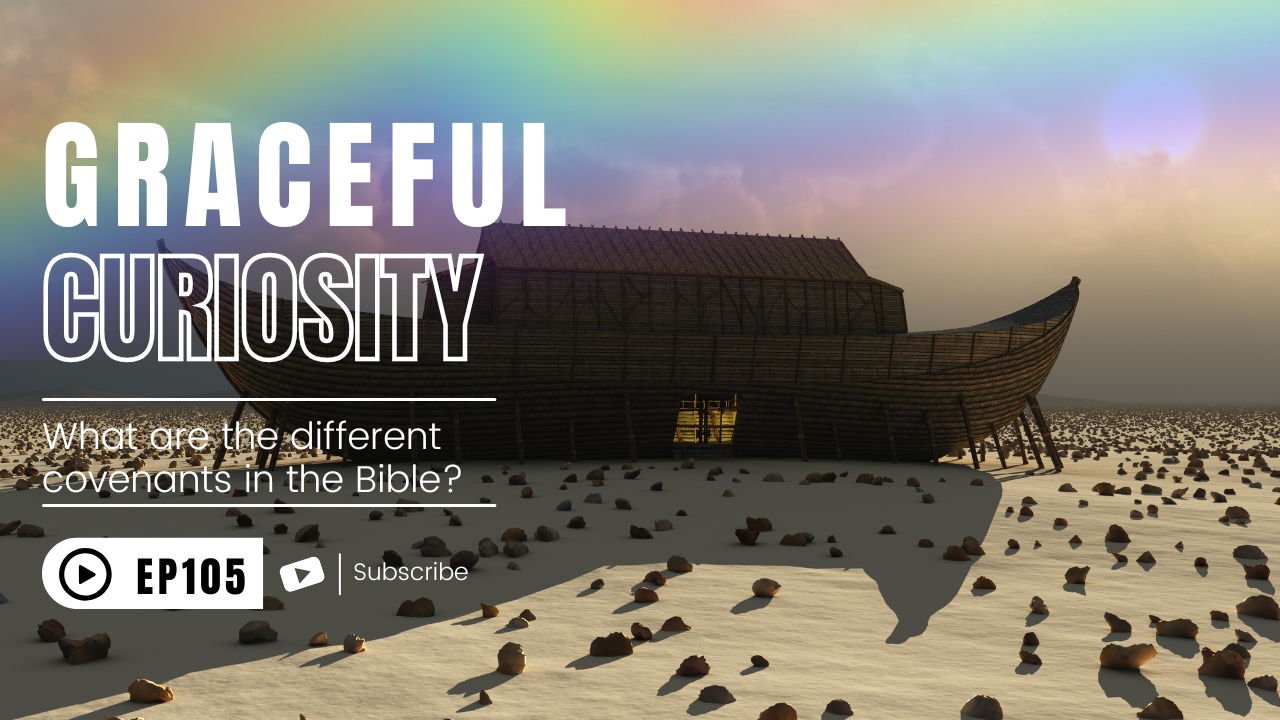
Episode 105: What are the different covenants in the Bible?
Speaker: Henry Covert Series: What is Theology?
I can see clearly now the rain is gone, and I'm ready to dive into episode 105! This week on Graceful Curiosity, we explore the concept of covenants. What exactly are they? What purposes do they serve? Am I accountable for them? And much more. Enjoy! #Anglican #KatyTexas #ChurchinKaty #Protestant #Theology #theologypodcast
Understanding the Covenants of the Bible: God's Faithfulness Through History
When Christians talk about the story of the Bible, they often focus on major events: creation, the fall, the Exodus, the kingdom of Israel, the coming of Christ, and the birth of the Church. But underneath all of those events runs a unifying theme that ties the entire story together: God's covenants.
Understanding the covenants helps us see the Bible not as a collection of disconnected stories, but as one unified account of God's faithfulness and His plan to redeem humanity.
What Is a Covenant?
At its simplest, a covenant is an agreement between two parties. In everyday life, we see similar arrangements in treaties, contracts, and business agreements. Typically, both parties have responsibilities, and a covenant can be broken if one side fails to uphold its commitments.
Biblical covenants, however, are different. In every biblical covenant, one of the parties is God Himself. Unlike humanity, God never fails in His commitments. He never breaks His promises. Even when people fail repeatedly, God remains faithful. This faithfulness becomes one of the defining themes of Scripture. The covenants reveal a God who consistently works toward redemption despite humanity's repeated failures.
The Edenic Covenant: Humanity's Original Purpose
The first covenant appears in the Garden of Eden. God creates humanity in His image and gives Adam and Eve responsibility over creation. They are called to exercise dominion, steward the earth, multiply, and enjoy fellowship with God. They are also given a command not to eat from the Tree of the Knowledge of Good and Evil. This covenant reveals God's original intention for human beings: relationship, purpose, and partnership in caring for creation. But humanity does not remain faithful.
The Adamic Covenant: The Promise Within Judgment
After Adam and Eve's disobedience, the consequences of sin enter the world. Pain, toil, hardship, and death become realities of human existence. Yet even in judgment, God offers hope. Within the curse is a promise: a future deliverer will come. God declares that the offspring of the woman will ultimately crush the serpent's head. Christians have long understood this as the first promise of Christ's coming redemption. From the very beginning, God's plan is not merely punishment but restoration.
The Noahic Covenant: God's Promise to Preserve Creation
As humanity's corruption grows, God brings judgment through the flood. Yet Noah finds favor with God and becomes the means through which creation is preserved. After the flood, God establishes a covenant with Noah, promising never again to destroy the earth through a global flood. The rainbow becomes the sign of this covenant. The Noahic Covenant demonstrates God's commitment to preserving His creation despite humanity's sinfulness. It is a reminder that God's purposes continue even when judgment is necessary.
The Abrahamic Covenant: A Blessing for All Nations
The next major covenant comes with Abraham. God calls Abraham to leave his homeland and follow Him. In return, God promises several extraordinary things:
- Abraham will become a great nation.
- His descendants will inherit the Promised Land.
- His offspring will become numerous.
- Through him, all nations of the earth will be blessed.
The sign of this covenant is circumcision. Yet perhaps its most important feature is the promise that through Abraham's line, God will bring blessing to the entire world. Christians see this promise fulfilled ultimately in Jesus Christ.
The Abrahamic Covenant moves the story of redemption forward, narrowing God's redemptive plan through a chosen people while maintaining His intention to bless all humanity.
The Mosaic Covenant: Forming God's Covenant People
Generations later, Abraham's descendants find themselves enslaved in Egypt. God raises up Moses to lead His people to freedom.
At Mount Sinai, God establishes a covenant with Israel. He gives the Law and formally sets Israel apart as His covenant nation. The covenant includes blessings for obedience and consequences for disobedience, while also providing instructions for worship, community life, and holiness. The Mosaic Covenant is often called the Sinai Covenant or the Old Covenant. It represents God's formation of Israel into a distinct people through whom His purposes would be revealed to the world.
The Land Covenant: Reaffirming God's Promises
As Israel prepares to enter the Promised Land, God reiterates His commitment to give them the inheritance promised to Abraham. This covenant serves as a reminder that God's promises remain active across generations. Although the previous generation failed to enter because of their disobedience, God remains faithful and prepares the next generation to receive His promises. The Land Covenant highlights an important truth: God's faithfulness is not dependent upon human perfection.
The Davidic Covenant: The Promise of an Eternal King
One of the most important developments in Israel's history comes through King David. God promises David that his throne will endure forever and that a future king from his line will establish an everlasting kingdom.
This covenant becomes central to Jewish hope and expectation. For centuries, Israel awaited a Messiah who would come from David's lineage. The New Testament repeatedly identifies Jesus as the "Son of David," emphasizing that He is the fulfillment of this covenant promise. Once again, God's redemptive plan grows clearer.
The New Covenant: Fulfillment in Christ
The culmination of all the covenants arrives in Jesus Christ. The prophets Jeremiah and Ezekiel spoke of a coming covenant that would differ from those before it. God would forgive sins, transform hearts, write His law upon His people's hearts, and pour out His Spirit. Jesus establishes this New Covenant through His death and resurrection.
Under the New Covenant:
- Sins are forgiven.
- Believers receive the Holy Spirit.
- Hearts are transformed.
- Relationship with God is restored.
- Eternal life becomes available to all who trust in Christ.
This covenant fulfills the promises embedded throughout the entire biblical story. The hope introduced in Eden, reaffirmed through Abraham, anticipated through David, and proclaimed by the prophets finds its fulfillment in Jesus.
The Story Behind Every Covenant
When viewed together, the covenants reveal a remarkable pattern. Humanity repeatedly fails. God remains faithful. Human beings break trust, abandon obedience, and pursue their own paths. Yet throughout every generation, God continues moving history toward redemption.
The covenants are not merely theological concepts. They are evidence of God's unwavering commitment to restore what was lost in Eden. His goal has always been the same: to bring humanity back into a right relationship with Himself.
Why the Covenants Matter Today
For Christians today, the covenants provide confidence in God's character. The same God who remained faithful to Noah, Abraham, Moses, David, and Israel remains faithful today. His promises are dependable because His character is unchanging.
The covenants remind us that the Bible is one story, not many stories. They demonstrate that God's plan of redemption was never an afterthought. From the beginning, He has been working toward restoration, forgiveness, and reconciliation. Ultimately, the covenants tell the story of a God who never gives up on His people and whose faithfulness stretches from Genesis to Revelation. And that may be the most beautiful covenant promise of all.